



The Zeigarnik Effect in Video Game Design
 Milijana Komad / 10min
Keywords: Zeigarnik effect, product design, cognitive psychology, user experience.
Abstract:
In the annals of psychological research, the Zeigarnik Effect stands as a seminal concept that was astutely discerned by the distinguished Russian psychologist, Bluma Zeigarnik, in the 1920s. Her pioneering work brought to the fore a captivating revelation: the human psyche demonstrates a proclivity to retain and ruminate upon unfulfilled tasks with greater acuity than those that have reached fruition. The core essence of this effect reverberates through the cross-section of both psychology and product design, intimating profound implications in the realm of user engagement, motivation, and overall experience.
The present exposition delves deep into the intricacies of the Zeigarnik Effect, traversing the dual avenues of its psychological underpinnings and its pragmatic application within product design paradigms. Through meticulous analysis, buttressed by empirical evidence and case studies, we endeavour to shed light on the mechanisms through which product designers, armed with an understanding of this phenomenon, can ingeniously craft products that resonate with the very core of human cognitive tendencies.
A focal point of this exploration is the gaming industry — an arena where user engagement and retention are paramount. By extrapolating the principles of the Zeigarnik Effect onto the gaming milieu, we unearth nuances of how this cognitive phenomenon interplays with task completion, player motivation, and engagement metrics. The potency of this effect within the gaming domain underscores the capacity to engender a rich and immersive user experience. This scholarly paper, therefore, not only maps out the theoretical contours of the Zeigarnik Effect but also positions it within the pragmatic landscape of game design.
Furthermore, through a compendium of meticulously curated case studies, we chronicle the tangible manifestations of the Zeigarnik Effect in the contemporary gaming ecosystem. These narratives, rooted in real-world applications, furnish a tangible testament to the transformative potential of this psychological phenomenon when adroitly integrated into product design.
In essence, as we traverse the rich tapestry of the Zeigarnik Effect, we stand at the confluence of historical psychological insight, modern product design imperatives, and the ever-evolving dynamics of the gaming industry — weaving together a comprehensive scholarly discourse on a concept that continues to influence and inspire.
Introduction
In the bustling ambiance of a 1920s Vienna restaurant, the astute observations of Bluma Zeigarnik unveiled a profound psychological enigma. It was within this setting that Zeigarnik discerned a remarkable disparity in the recall abilities of the waitstaff. With uncanny precision, they retained intricate details of outstanding orders, while memories of fulfilled requests swiftly faded into oblivion. Such a juxtaposition of memory retention prompted Zeigarnik to theorize on the cognitive processes that underlie task completion and retention, culminating in what has now been immortalized as the ‘Zeigarnik Effect’.
Eponymously named after the Soviet psychologist, the Zeigarnik Effect delves into the human propensity to hold onto and remember unfinished or interrupted tasks with markedly greater clarity than those that have been completed. This cognitive phenomenon does not merely stand as an isolated psychological curiosity but has interwoven itself into the very fabric of diverse disciplines, ranging from advertising and education to the pulsating realm of gaming.
The gaming industry, in particular, has been significantly influenced by this effect. The inherent mechanics of task interruptions and the ensuing anticipation in games dovetail seamlessly with the tenets of the Zeigarnik Effect, making it an instrumental tool in shaping player engagement and motivation. When a player is left on the cusp of achievement, the unresolved nature of the task fuels a compulsion to persevere, fostering prolonged engagement and commitment to the game.
But the reach of the Zeigarnik Effect extends even beyond gaming. In marketing, it elucidates consumer behaviour patterns, while in education, it offers pedagogical insights into learner retention. The world of product design, too, remains indebted to this effect. By understanding the innate human inclination toward unresolved tasks, designers have been able to craft experiences that harness this pull, creating products that continually engage and captivate users.
As we stand on the cusp of a century since Zeigarnik’s initial observations, the effect bearing her name remains as pertinent as ever. It acts as a beacon, illuminating our understanding of human cognition and its intricate dance with memory, task completion, and engagement. As scholars and practitioners, we continually delve into its depths, uncovering the myriad ways it shapes behaviours and experiences across diverse domains.

The Zeigarnik Effect: An Overview
Zeigarnik (1927) discovered this effect during her research when she noticed that waitstaff at a restaurant could remember details about unpaid orders, but the memory of these details vanished once the bill was settled. Inspired by this observation, she conducted a series of experiments to investigate the phenomenon, eventually leading to the identification and naming of the Zeigarnik effect.
The underlying psychological process that facilitates the Zeigarnik effect is thought to be related to the state of tension that arises from an unfinished task. The tension acts as a task-specific motivator, prompting the individual to complete the task and resolve the tension. The memory associated with this tension is stronger than the memory of a task without such tension, thus resulting in better recall for unfinished tasks.
“Creativity is nothing but a mind set free.”
Torrie T. Asai
Understanding the Zeigarnik Effect: A Psychological Perspective
Bluma Zeigarnik discovered this phenomenon while observing a waiter who could remember all the details of unpaid orders but promptly forgot these details once the bills were settled. This led her to conduct experiments, confirming that humans indeed remember unfinished tasks more readily than completed ones. The Zeigarnik effect suggests a mental tension and discomfort created by an unresolved task, causing the brain to remember it more vividly.
Understanding the human cognitive process, including phenomena like the Zeigarnik effect, enables product designers to create more engaging and user-friendly products. The psychological discomfort associated with the incompletion nudges users to return and complete the task, increasing the product’s engagement and retention.
Zeigarnik Effect in Product Design
In product design, the Zeigarnik Effect is often applied to design user experiences that increase engagement, foster habitual use, and promote customer retention. The idea is to create a product that constantly offers unfinished tasks, which, according to Zeigarnik’s theory, will linger in the user’s memory, prompting them to return and complete the task. In digital product design, LinkedIn’s profile completion bar is a case in point. By showing users that their profile is “85% complete,” LinkedIn leverages the Zeigarnik effect to motivate users to fully complete their profiles.
Application in the Gaming Industry
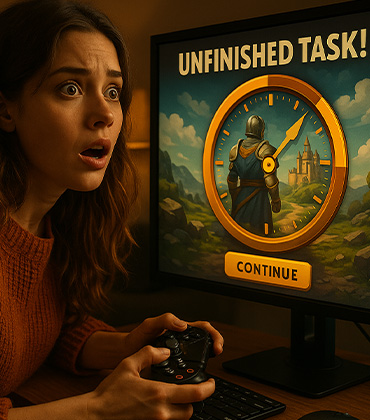
In the gaming industry, the application of the Zeigarnik Effect is particularly salient. Game designers incorporate tasks and missions that require multi-stage completion, intermittent rewards, and strategic cliffhangers to keep players engaged and motivated. This technique capitalizes on the fact that gamers will be mentally engaged with the game, even when they are not playing, as the unfinished tasks stay with them.
The Zeigarnik Effect in Gaming: Case Studies
Case Study 1: World of Warcraft (WoW)
One of the most prominent examples of the Zeigarnik effect in gaming is found in World of Warcraft (WoW). WoW employs a sophisticated quest system, a significant part of which comprises multi-part, long-term quests that often require players to take breaks before completion. These unfinished tasks create a state of tension that encourages players to return to the game to complete the quest. This psychological mechanism contributes significantly to WoW’s high player engagement and retention rates.
Case Study 2: Candy Crush Saga
In the mobile gaming sphere, Candy Crush Saga effectively exploits the Zeigarnik effect. The game includes numerous short, engaging levels that gradually increase in difficulty. Often, players are unable to complete a level within their first few attempts, leaving the task unfinished. The desire to complete these unfinished levels draws players back to the game, thereby improving engagement and player retention.
Case Study 3: The Legend of Zelda: Breath of the Wild
Another illustrative example is The Legend of Zelda: Breath of the Wild, an open-world game with numerous side quests and exploration opportunities. Many tasks are purposely designed to take a considerable amount of time, encouraging players to take breaks before their completion. This design technique amplifies the Zeigarnik effect, increasing player engagement and encouraging return play.
Case Study 4: Fortnite Battle Royale
In Fortnite Battle Royale, the battle pass system is a perfect demonstration of the Zeigarnik Effect. The battle pass provides a series of tiers that players unlock through gameplay. Each tier rewards the player with in-game items, but reaching the next tier requires consistent effort. As a result, players are left with an unfinished task after each game session, compelling them to return and continue their progress.
Implications and Future Research Directions:
The Zeigarnik effect presents potential opportunities and challenges for the gaming industry. On the one hand, it offers a mechanism to increase player engagement and motivation; on the other hand, it poses ethical considerations concerning the potential for exploitative game design.
Given the substantial influence of the Zeigarnik effect on player behavior, it is crucial to explore this phenomenon further. Future research could focus on understanding how different game design elements and player characteristics interact with the Zeigarnik effect. Moreover, investigating ethical strategies for leveraging the Zeigarnik effect could provide valuable insights for developing player-centric game designs.
Conclusion
In conclusion, the Zeigarnik Effect emerges as a potent instrument within the domain of product design, holding particular gravitas within the gaming industry. This phenomenon capitalizes on the inherent psychological predilections of individuals to see tasks through to their conclusion. From a deeper psychological vantage, it presents as a window into the cognitive mechanics driving human engagement and motivation. This cognizance of incomplete tasks not only acts as a psychological anchor, perpetually pulling users back into the gaming environment, but also serves as a blueprint for constructing intricate and immersive gaming narratives.
Several case studies elucidate the meticulous integration of this phenomenon into the very fabric of game design, facilitating the crafting of a gaming experience that is both captivating and memorable. Such deliberate design decisions, rooted in cognitive psychology, underscore the intricate dance between game mechanics and human behaviour.
However, as the gaming milieu continues its rapid evolutionary trajectory, the modalities of employing the Zeigarnik Effect are bound to metamorphose in tandem. This necessitates an ongoing dialogue and inquiry into its application, ensuring it serves the dual purpose of enriching the user experience while safeguarding against potential over-indulgence or dependency.
Furthermore, as the boundaries between disciplines become increasingly porous, the interweaving of psychological tenets into product design portends a future where user engagement is not a mere byproduct but a deliberately orchestrated outcome. This synergy between psychology and design serves as a testament to the limitless possibilities that lie at the confluence of understanding the human psyche and tailoring products to resonate with these inner workings. It’s paramount, however, to approach such integrations with a keen ethical compass, ensuring that while we leverage cognitive processes for engagement, we remain vigilant against the potential for undue manipulation or adverse repercussions.

References:
1. Zeigarnik, B. (1927). On finished and unfinished tasks. In W. D. Ellis (Ed.), A sourcebook of Gestalt psychology (pp. 300–314). Harcourt, Brace & World.
2. Weiner, B. (1972). Theories of motivation: From mechanism to cognition. Markham Publishing Company.
3. Norman, D. A. (1988). The psychology of everyday things. Basic books
4. Schell, J. (2014). The Art of Game Design: A Book of Lenses. CRC Press.
5. Chou, Y. (2015). Actionable gamification: Beyond points, badges, and leaderboards. Octalysis Media.
6. World of Warcraft. (2004). Blizzard Entertainment.
7. Candy Crush Saga. (2012). King.
8. The Legend of Zelda: Breath of the Wild. (2017). Nintendo.
9. Fortnite Battle Royale. (2017). Epic Games.





Related posts

Psychology / Design

Psychology / Design
The Mechanism of Skinner Box Techniques in Video Game Design

Psychology / Design
The Exploitation of Fear of Missing Out (FOMO) in Video Game Design
DIGITAL DESIGN EXPERIENCE
MILIJANA KOMAD