



The Role of Grinding in Video Game Design
 Milijana Komad / 10min
Keywords: Grinding, Video Gaming, Game Design, Player Engagement, Psychological Manipulation
Abstract:
This paper scrutinizes the utilization of “grinding” as a technique in video game design, particularly as a method of psychological manipulation that affects player engagement and behaviour. Case studies are explored to deliver a comprehensive understanding of the practical application of grinding and its implications, all from a product design viewpoint.
Introduction
The design principles governing video games frequently incorporate mechanisms intended to stimulate player engagement and prolong interaction time. One such prevalent mechanism is “grinding,” defined as the practice of executing repetitive tasks within the game environment to achieve specific objectives. While grinding can evoke a sense of achievement, it also carries the potential to induce exhaustion and frustration among players. This study endeavours to explore the intricacies of grinding, its role in game design, and its influence on player experience.
Explanation
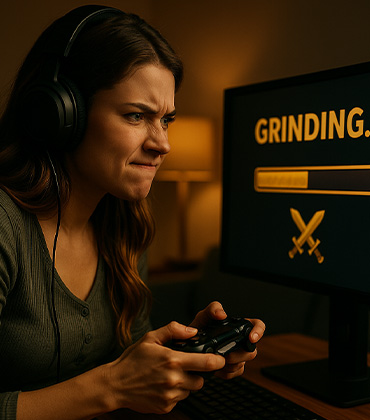
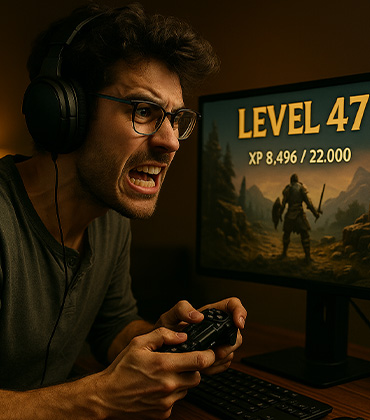
Coined from the concept of persistently “grinding away” at a task, the term “grinding” in the gaming context implies the undertaking of repetitive actions by a player to attain certain results or to advance within the game. In numerous instances, such actions may not directly correlate with the game’s primary storyline or objectives but are aimed at accumulating experience points, in-game currency, or specialized items.
Grinding is an omnipresent component across a vast array of game genres, with its prominence notably manifested in Massively Multiplayer Online Role-Playing Games (MMORPGs). In these games, the player’s progression and performance are often gauged based on their character’s level, skills, and available equipment.
From the standpoint of game design, grinding assumes several roles. It serves to extend the game’s lifespan by instituting goals that necessitate substantial time investment. Additionally, it fosters a sense of accomplishment and progression and can encourage social interaction in multiplayer environments. Despite these advantages, critics contend that grinding can lead to monotonous and ungratifying gameplay experiences. The considerable time commitment required by grinding may propel some players towards purchasing in-game enhancements using real-world money, thereby generating additional revenue for game developers.
Further, there is an ongoing discourse concerning the psychological implications of grinding. Its repetitive and rewarding nature might precipitate addictive behaviours and excessive consumption of time, mirroring the effects typically associated with gambling disorders. Through the exploration of these aspects, we aim to shed light on the complex dynamics of grinding in the context of modern video gaming.
“Every great design begins with an even better story.”
Lorinda Mamo
Grinding in Gaming: Conceptualization and Design
Grinding typically refers to the act of performing repetitive actions in a game to attain a specific goal, often associated with levelling up, obtaining items, or advancing in-game skills. Although it can give players a sense of progression, it can also serve as a roadblock, encouraging players to consider alternative paths to progress, such as microtransactions.
Case Study: World of Warcraft
Blizzard Entertainment’s World of Warcraft (WoW) extensively employs grinding. Players often engage in repetitive tasks like fighting the same enemies or completing the same quests to gain experience points, in-game currency, or items. This grind contributes to a sense of achievement but has also been criticized for sometimes leading to a tedious gameplay experience.
Case Study: Candy Crush Saga
King’s Candy Crush Saga uses grinding as a monetization strategy. As players progress and levels become harder, the option to grind through the game becomes more attractive. Alternatively, players can buy power-ups and boosters to surpass the grind, effectively translating grinding mechanics into revenue for the game developers.
Case Study: World of Warcraft (WoW)
In WoW, a seminal MMORPG, players frequently engage in grinding to increase their character’s level or acquire rare items. This might involve repeatedly battling against non-player characters (NPCs) to accrue experience points or performing the same quest multiple times to earn specific loot or currency.
Case Study: Destiny 2
This game provides an example of a ‘loot grind.’ Players repeatedly complete activities like strikes, raids, or public events to earn ‘engrams’ — randomized gear drops. The goal is often to collect more powerful gear to increase a character’s power level.
Case Study: Old School RuneScape
In this MMORPG, players might grind by repetitively performing tasks like mining, fishing, or woodcutting. These actions, though monotonous, boost the player’s skill levels, enabling them to perform new tasks, quests, or create new items.
Implications for Game Design
Grinding, while a tool to extend game playtime and potentially drive monetization, must be thoughtfully implemented to avoid player fatigue or burnout. Game designers should strike a balance between meaningful progression and repetitive grind, ensuring the game remains engaging and satisfying.
Conclusion
Grinding, as a mechanism of psychological manipulation in video game design, can greatly impact player behaviour and engagement. Striking a balance between challenge, satisfaction, and repetition is vital to ensure a rewarding gameplay experience. As the video game industry advances, it will be intriguing to observe the evolution and refinement of grinding mechanisms and their psychological impact on players.
References:
1. Sicart, M. (2013). Grinding in Games: Understanding the Appeal. Philosophy of Computer Games Conference, 8–11.
2. Hamari, J., Alha, K., Järvelä, S., Kivikangas, J. M., Koivisto, J., & Paavilainen, J. (2017). Why do players buy in-game content? An empirical study on concrete purchase motivations. Computers in Human Behavior, 68, 538–546. doi:10.1016/j.chb.2016.11.045
3. Blizzard Entertainment. (2004). World of Warcraft [Video Game]. Blizzard Entertainment.
4. King. (2012). Candy Crush Saga [Video Game]. King.
5. Bungie. (2017). Destiny 2 [Video Game]. Activision.
6. Jagex. (2013). Old School RuneScape [Video Game]. Jagex.
7. Yee, N. (2006). Motivations of play in online games. CyberPsychology & Behavior, 9(6), 772–775. doi:10.1089/cpb.2006.9.772
8. Johnson, M. R., & Woodcock, J. (2019). The impacts of live streaming and Twitch.tv on the video game industry. Media, Culture & Society, 41(5), 670–688. doi:10.1177/0163443718818363
9. King, D., Delfabbro, P., & Griffiths, M. (2010). Video game structural characteristics: A new psychological taxonomy. International Journal of Mental Health and Addiction, 8(1), 90–106. doi:10.1007/s11469–009–9206–4
10. Deterding, S., Dixon, D., Khaled, R., & Nacke, L. (2011). From game design elements to gamefulness: defining “gamification”. MindTrek ’11: Proceedings of the 15th International Academic MindTrek Conference: Envisioning Future Media Environments, 9–15. doi:10.1145/2181037.2181040





Related posts
Psychology / Design

Psychology / Design
Exploring Gacha Mechanics in Video Game Design
Psychology / Design
The Zeigarnik Effect in Video Game Design
DIGITAL DESIGN EXPERIENCE
MILIJANA KOMAD